Home / Kata

Kata

The Shotokan kata

Formal sequences at the heart of Shotokan training, listed with the club’s grading kata for each belt.

Shotokan karate

The 26 kata

A guide to the formal sequences, alongside the club’s grading syllabus.

Grading syllabus

Kata are formal sequences of defensive and attacking techniques. In Shotokan they are one of the three foundations of training, together with kihon (basics) and kumite (partner work). Practising kata develops stance, timing, direction, spirit and an understanding of technique. Students work through a set order as they progress.

At this club, the first examined kata is Taikyoku Shodan, a foundation form that is not one of the standard 26 Shotokan kata. Students then work through the five Heian kata, Tekki Shodan, Bassai Dai, and onward through Kanku Dai, Jion, Enpi, Hangetsu, Jitte, Gankaku and the remaining advanced kata.

The table below shows the kata examined at each kyu grade and for first dan, as confirmed by the club. The full kihon, kata and kumite for each kyu grade, with demonstration videos, is on the Grading syllabus page. Further demonstration videos are in the advanced kata section below. If you are preparing for a grading, please ask your instructor.

Grading kata by belt

BeltGradeKata
Red9th kyuTaikyoku Shodan
Orange8th kyuHeian Shodan
Yellow7th kyuHeian Nidan
Green6th kyuHeian Sandan
Purple5th kyuHeian Yondan
Purple and white4th kyuHeian Godan
Brown3rd kyuTekki Shodan
Brown2nd kyuBassai Dai
Brown and white1st kyuTekki Shodan
Black1st danBassai Dai

Foundation kata

Before the official 26, the club examines Taikyoku Shodan for the first kyu grade.

太極初段

Taikyoku Shodan

First cause — first level

A short, straightforward pattern of basic stances, blocks and punches. It is a foundation kata, taught as preparation for the Heian series, and is not one of the standard 26 Shotokan kata.

Grading kata The club’s grading kata for 9th kyu (red belt).

The Heian kata

The five Heian kata follow Taikyoku Shodan and are the club’s grading kata from 8th kyu to 4th kyu.

平安初段

Heian Shodan

Peaceful mind — first level

Introduces the fundamental stances, blocks and punches in a clear pattern. The first of the five Heian kata, and the next formal sequence after Taikyoku Shodan.

Grading kata The club’s grading kata for 8th kyu (orange belt).

平安二段

Heian Nidan

Peaceful mind — second level

Builds on Heian Shodan with more varied blocking, kicking and changes of direction.

Grading kata The club’s grading kata for 7th kyu (yellow belt).

平安三段

Heian Sandan

Peaceful mind — third level

Develops close-range technique, including work in kiba-dachi (horse stance) and tighter changes of direction.

Grading kata The club’s grading kata for 6th kyu (green belt).

平安四段

Heian Yondan

Peaceful mind — fourth level

Combines more complex kicking, double-hand techniques and changes of rhythm.

Grading kata The club’s grading kata for 5th kyu (purple belt).

平安五段

Heian Godan

Peaceful mind — fifth level

Completes the Heian series, including a jump and more advanced combinations.

Grading kata The club’s grading kata for 4th kyu (purple and white belt).

Tekki Shodan and the selected kata

Tekki Shodan and Bassai Dai are the club’s brown-belt and first-dan grading kata. Kanku Dai, Jion, Enpi, Hangetsu, Jitte and Gankaku follow in the usual order of study, at dan grades.

鉄騎初段

Tekki Shodan

Iron horse — first level

Practised throughout in kiba-dachi (horse stance). Develops a strong stance, hip action and close-range technique. The first of the three Tekki kata.

Grading kata The club’s grading kata for 3rd kyu (brown) and again for 1st kyu (brown and white).

抜塞大

Bassai Dai

To storm a fortress — greater

A strong, decisive kata, changing from defence to counter-attack.

Grading kata The club’s grading kata for 2nd kyu (brown) and for 1st dan (black belt).

観空大

Kanku Dai

To view the sky — greater

The longest of the commonly studied earlier kata. It opens with the characteristic movement of viewing the sky. Many techniques in the Heian kata can be traced back to it.

Study Studied at dan grades.

慈恩

Jion

Mercy and gratitude; also understood as a temple name

A composed, formal kata with strong basic technique.

Study Studied at dan grades.

燕飛

Enpi

Flight of the swallow

Light, quick changes of height and direction. Also written Empi.

Study Studied at dan grades.

半月

Hangetsu

Half-moon

Distinguished by hangetsu-dachi (half-moon stance) and slower, stronger breathing with contraction and expansion.

Study Studied at dan grades.

十手

Jitte

Ten hands

A compact kata of strong blocking technique.

Study Studied at dan grades.

岩鶴

Gankaku

Crane on a rock

One-legged stances develop balance, timing and composure.

Study Studied at dan grades.

Further kata

The remaining kata of the standard Shotokan 26 are studied at dan grades. The two Gojushiho kata are listed with the usual Dai and Sho labels; naming of the pair has not always been the same in every association.

鉄騎二段

Tekki Nidan

Iron horse — second level

Continues the Tekki series in kiba-dachi, with further close-range technique and hip work.

Study Studied at dan grades.

鉄騎三段

Tekki Sandan

Iron horse — third level

Completes the three Tekki kata, still practised in kiba-dachi.

Study Studied at dan grades.

抜塞小

Bassai Sho

To storm a fortress — lesser

The shorter companion to Bassai Dai, generally studied at dan grade.

Study Studied at dan grades.

観空小

Kanku Sho

To view the sky — lesser

The shorter companion to Kanku Dai, generally studied at dan grade.

Study Studied at dan grades.
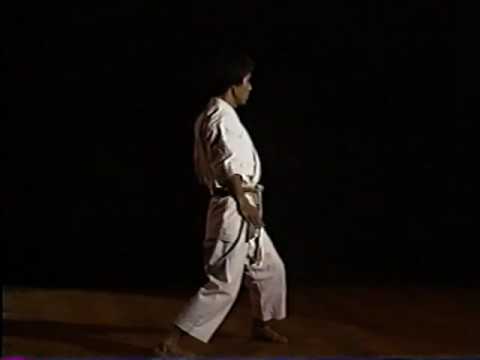
珍手

Chinte

Rare hands, or unusual hands

Distinguished by unusual circular and close-range hand techniques.

Study Studied at dan grades.
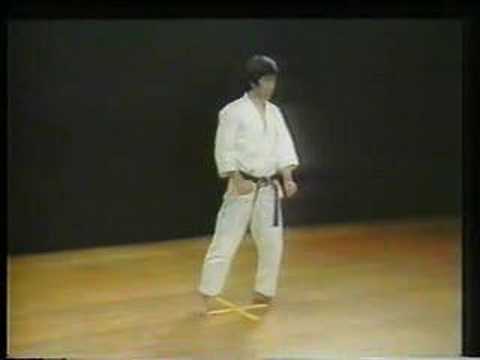
壮鎮

Sochin

Strength and calm

Characterised by a strong, rooted stance (sochin-dachi) and powerful, composed technique.

Study Studied at dan grades.

二十四歩

Nijushiho

Twenty-four steps

A flowing kata of 24 steps, with changing rhythm. Also written Niju Shiho.

Study Studied at dan grades.

五十四歩大

Gojushiho Dai

Fifty-four steps — greater

One of two long, advanced kata of 54 steps. The Dai and Sho labels for this pair have not always been applied in the same way by every association.

Study Studied at dan grades.
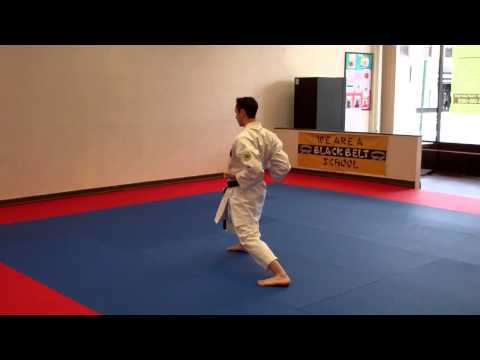
五十四歩小

Gojushiho Sho

Fifty-four steps — lesser

The companion 54-step kata. See the note on naming under Gojushiho Dai.

Study Studied at dan grades.

雲手

Unsu

Cloud hands

An advanced kata with rapid changes of direction and a distinctive jump.

Study Studied at dan grades.

明鏡

Meikyo

Bright mirror

Includes a distinctive turning movement often compared with polishing a mirror. Sometimes associated with the older name Rohai.

Study Studied at dan grades.

王冠

Wankan

King’s crown

The shortest of the 26 Shotokan kata.

Study Studied at dan grades.

慈陰

Jiin

Shade of mercy; also given as temple ground

Related in character to Jion. Less often used as a grading kata in some associations.

Study Studied at dan grades.

Advanced kata videos

You can watch some of the more advanced Shotokan kata being demonstrated by some of the art’s finest exponents here.

Bassai Dai - Sensei Masao Kawasoe
Tekki Shodan - Sensei Masao Kawasoe
Tekki Nidan - Sensei Kanazawa
Bassai Sho - Kanazawa Sensei
Jitte - Kanazawa Sensei
Jion - Kanazawa Sensei
Kanku Sho - Kanazawa Sensei
Gankaku - Kanazawa Sensei
Hangetsu - Sensei Masao Kawasoe
Wankan
Junro Shodan - Sensei Warren Levi
Junro Nidan - Sensei Warren Levi
Junro Sandan - Sensei Warren Levi
Junro Yondan - Sensei Warren Levi
Junro Godan - Sensei Warren Levi
Meikyo Shodan - Sensei Ohta
Meikyo Shodan - Sensei Kawasoe
Meikyo Nidan - Sensei Asai
Heian Oyo (Sensei Kase's Kata)
Nijushiho - Sensei Masao Kawasoe
Ten No Kata

See the grading syllabus

For classes and belt colours, see What you will practise and Progressing through the grades. Questions about starting at the club are answered in the FAQ.

Come and try a class

Your first 4 lessons are free.

Children from age 5 and adults of any age are welcome — no experience needed. Monday and Wednesday, 6:30–7:30pm in Hamilton.